Категорії
Last Updated: October 9, 2026
Workers in oil fields, power plants and welding shops need FR coveralls that will not melt, drip or stick to the skin in a flash fire. This guide covers industry scenarios, fabric types, standards and wholesale FR coveralls sourcing for team-size orders.
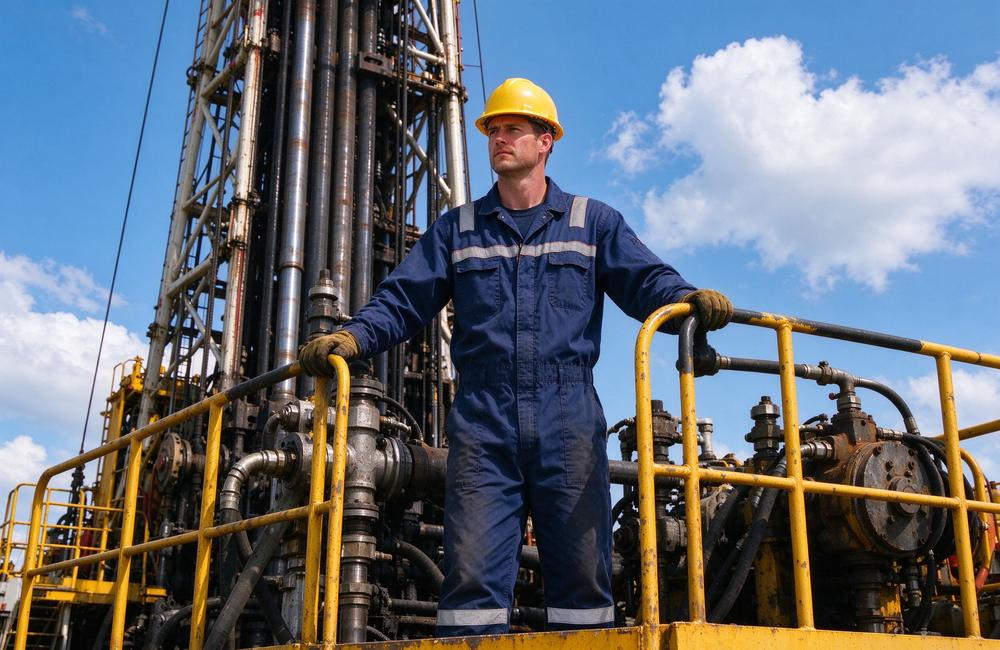
On the oil field, FR coveralls are the first line against flash fire
Oil fields and power plants send crews into heat every single shift, yet the two risks are not identical. A refinery worker faces process heat and flash fires; a maintenance electrician faces arc flash. Both need a coverall that resists ignition, limits burn injury and stays comfortable through a full workday. Seeing the two scenes side by side is the fastest way for a buyer to understand why one garment has to cover so many different threats.
FAQ
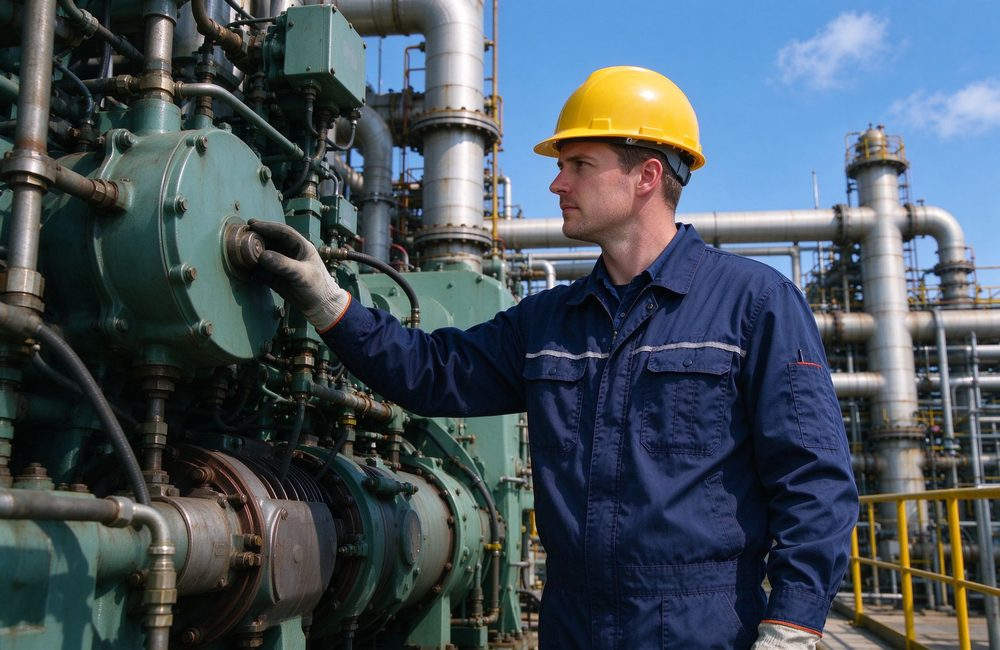
Power maintenance: arc flash protection is not a standard workwear job
In oil, power and welding, heat and flame arrive in different forms, but the common thread is that when an incident happens, workers have only seconds to react. FR coveralls are not designed to keep you from feeling heat — they are designed so that in the moment of a flash fire or arc event, the fabric self-extinguishes, does not melt and does not stick to the skin, keeping the injury level down. Choosing a compliant FR garment is buying visible insurance for the worst case.
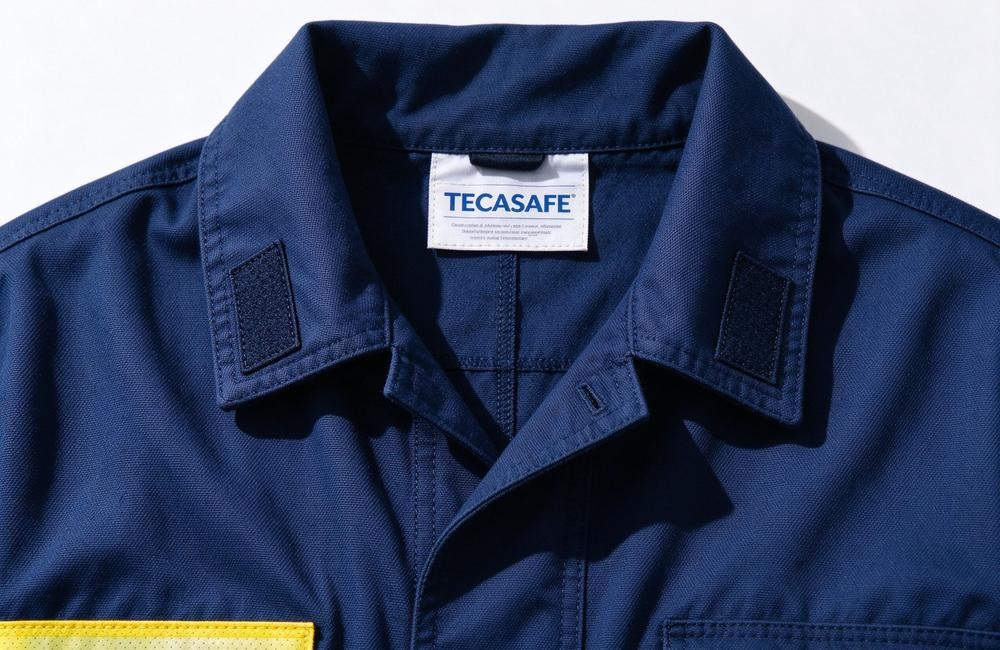
Inherently FR fabric: protection that does not wash out
Each industry has a different threat profile: oil fields fear flash fire, power operations fear arc flash, and welding shops fear molten metal splash. So buying should never stop at the phrase "it is flame resistant." Ask three questions instead: Is the fabric inherently FR or treated? Which standard does the garment meet? Does the certificate match the label model? A supplier who cannot answer these three questions should not make it onto your list, whatever the price.
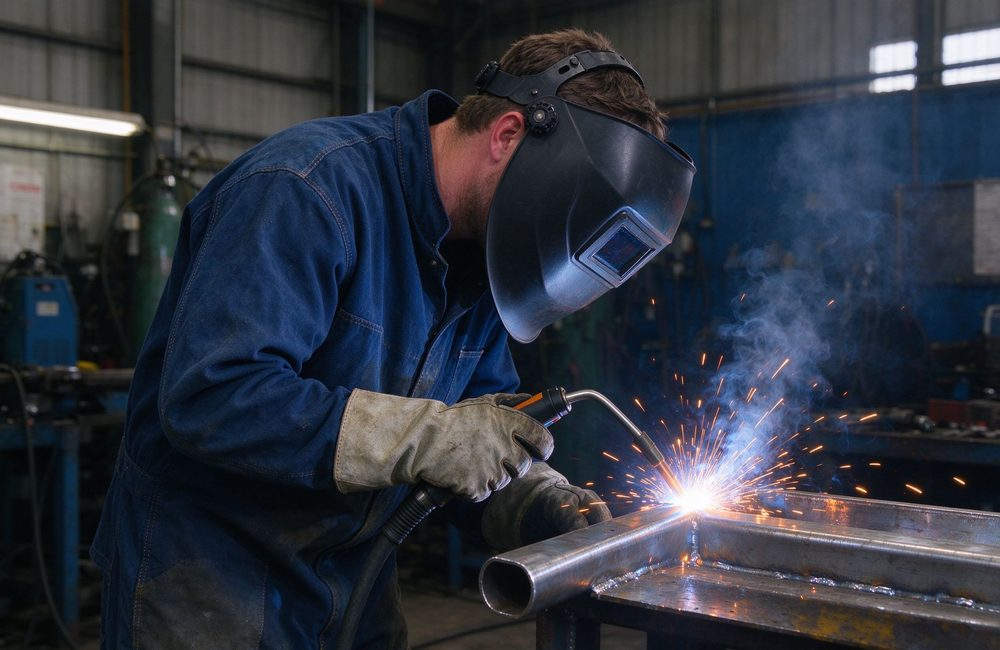
Welding shop: molten splash needs a heat-resistant outer layer
There is one more point wholesale buyers often miss: one company frequently serves oil, power and welding customers at the same time, and one crew may face all three hazards in a week. Instead of buying a separate suit for every scenario, it is often smarter to choose one inherently FR coverall built to multiple standards, cover several scenarios with a single fabric report, and save both budget and warehouse space. That is why "broad standard coverage" is becoming the norm in FR workwear wholesale.
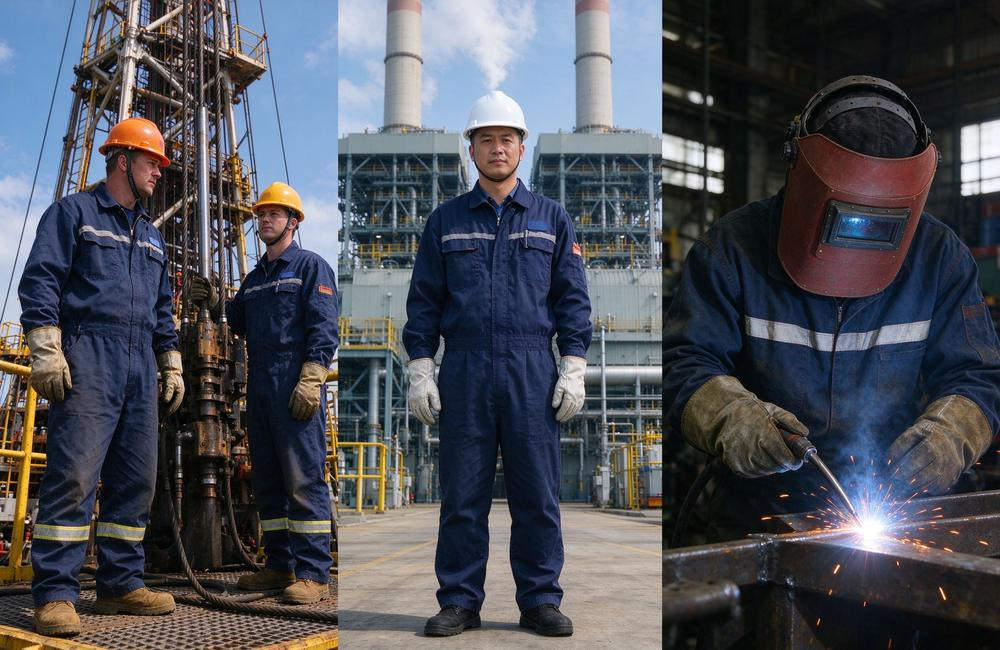
Three industries, three hazards, one FR logic
Each of the three industries buys FR coveralls for a different reason: oil buys flash fire protection, power buys arc flash protection, and welding buys molten splash protection. The same garment platform can serve all three when the fabric and standards are right — which is why one wholesale specification, rather than three separate product lines, is usually the efficient route for distributors and contractors who supply several sites at once.
FR coveralls are one-piece flame resistant workwear that covers the torso and limbs, designed so the fabric self-extinguishes when exposed to flame or high heat, does not sustain burning, and does not melt, drip or stick to the skin in a way that causes secondary burns. Compared with ordinary cotton workwear, FR coveralls significantly reduce burn area and burn depth in flash fire, arc flash and molten splash events. The roles that need them concentrate in three industries — oil and gas, power operations and welding — with chemical, metallurgy and heat-treatment plants also covered.
On drilling platforms, gas processing sites and pipeline maintenance jobs, a leak of flammable gas meeting an ignition source becomes a flash fire. Flash fires usually last only seconds, but the flame engulfs the entire area instantly. NFPA 2112 is the standard built for exactly this scenario: it requires fabrics that do not sustain burning and do not melt or drip under flash fire conditions, and it defines whole-garment test methods. For oil field workers, FR coveralls are the entry ticket to the danger zone, not an option.
Before comparing fabrics, separate the roles: a turnout coat is built for structural firefighting entry, while an FR coverall is a work garment worn all shift where fire is possible but not guaranteed. The two are often confused in procurement — keep this workwear mindset when you evaluate options.
Oil project purchasing habits are clear: NFPA 2112 goes straight into the tender document, and suppliers must provide a whole-garment flash fire test report. Flash fire does not wait, so the protection level must be fixed before anyone enters the site.
Within oil and gas, exposure is not uniform: drilling crews, production operators and maintenance welders face different hazards. One FR coverall specification can cover all of them if it meets the flash fire standard and leaves room for movement. Many oil companies also ask for anti-static properties because of the flammable atmosphere, which is why GB 12014-2019 and EN 1149-5 often appear beside FR requirements in their tenders.
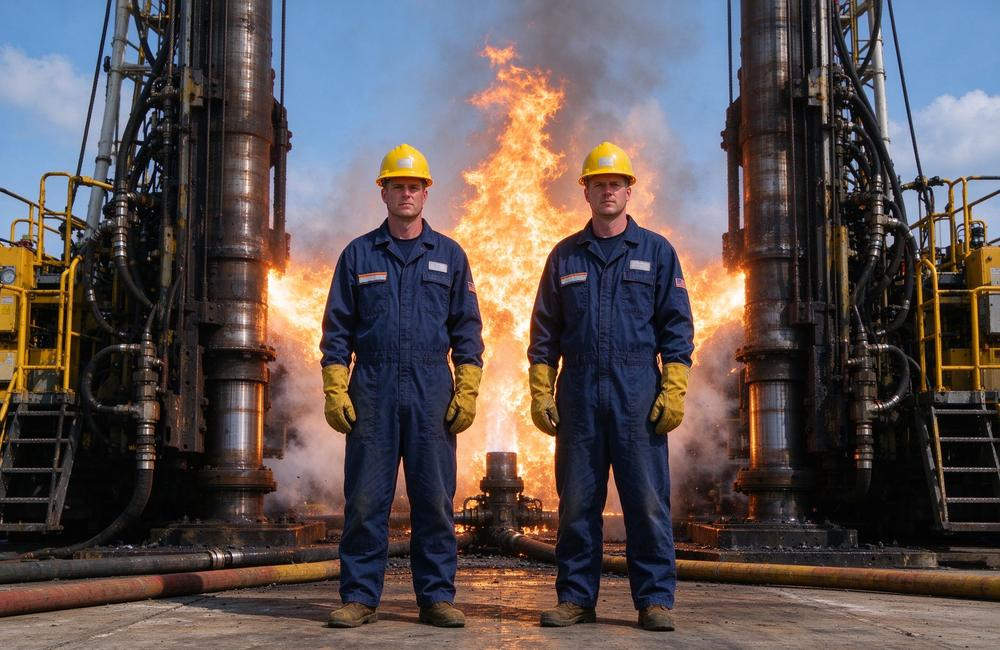
Drilling platform: flash fire protection is a hard entry requirement
Power plants, substations and distribution maintenance face not open flame but arc flash — the high-temperature plasma of a short circuit, with temperatures exceeding 19000°C. Arc heat can melt metal, ignite ordinary workwear and cause severe radiant burns. Power scenarios usually require an additional arc rating (for example the ATPV value measured by ASTM F1959), so the FR garment you choose should cover both flame resistance and arc protection rather than stopping at the word "flame resistant."
Arc protection is expressed in two systems: the ATPV value from ASTM F1959 and the HRC categories in NFPA 70E. The safety officer decides the required level from the task’s calculated incident energy; the supplier’s job is honest ATPV data and documented compliance. Ask how the rating was measured and whether the report model matches the label.
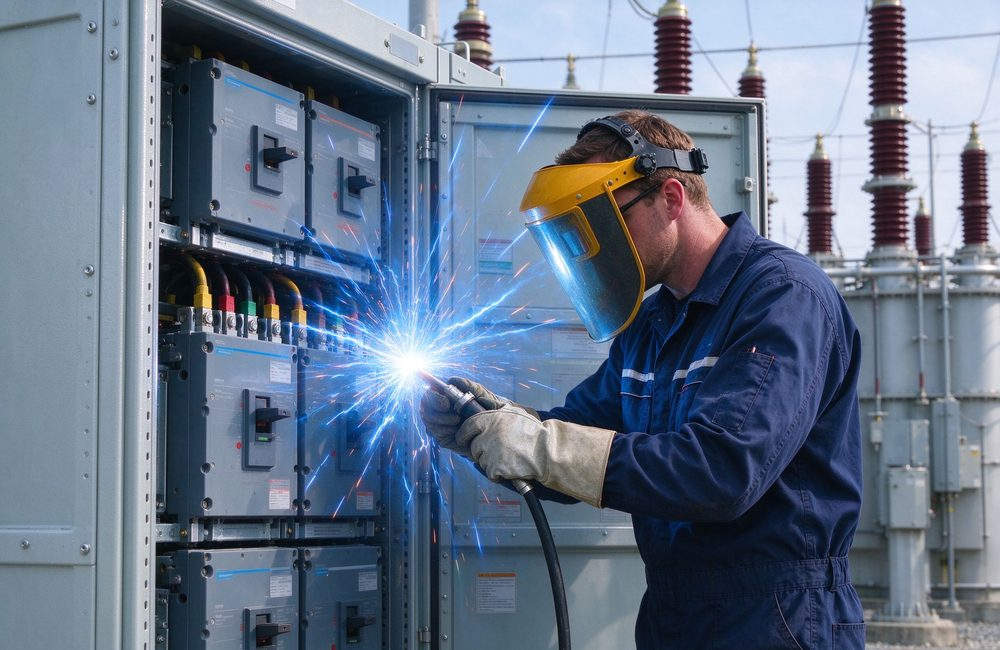
Substation maintenance: read the arc rating together with the FR rating
Welding and cutting produce high-temperature slag and sparks that land on clothing and keep burning into the fabric. Welding suits need an abrasion-resistant outer layer that resists slag adhesion, built to GB 8965.2-2022, the Chinese welding protective clothing standard. Blends of aramid, modacrylic and FR cotton are the common solution — they balance flame resistance, heat tolerance and everyday comfort. For welding-focused shops, size to a welding suit standard instead of substituting a general FR coverall.
Welding suits carry shop-floor details that matter: covered pockets so sparks cannot collect, adjustable cuffs that close over gloves, and seams that hold under repeated heat. Because welders work close to the arc, the outer fabric takes constant abuse, so abrasion resistance and ease of repair are part of the buying criteria too.
One more practical point: the coverall protects the torso and limbs, but the head, hands and face need matching protection in most scenarios. Hoods, gloves and face shields are usually quoted together with the suit, and their standards should be confirmed in the same document pack so the whole system, not just the garment, is compliant.
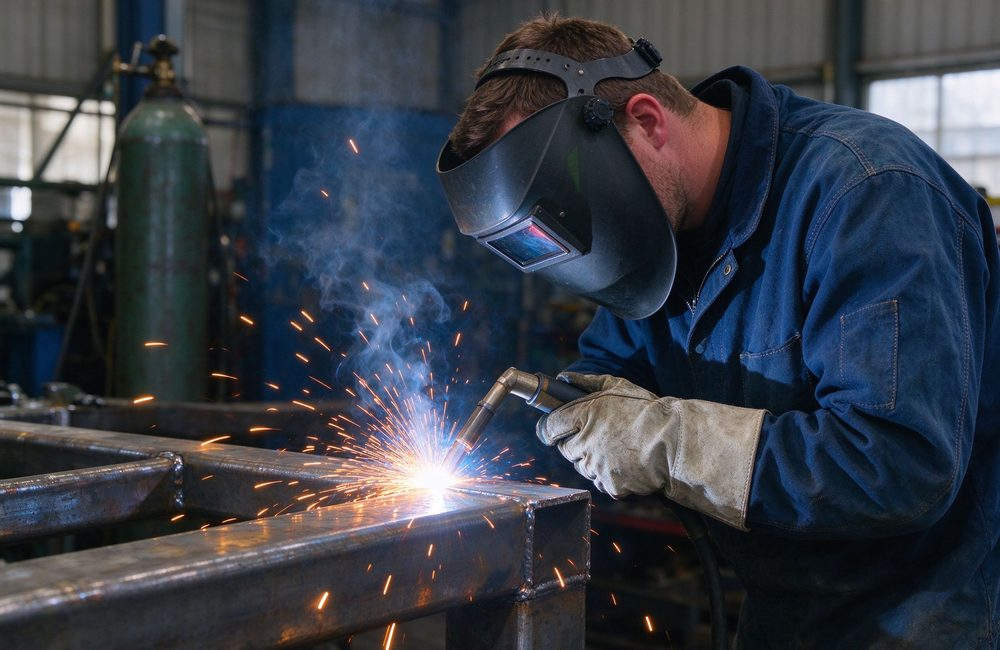
Splash protection: the outer layer absorbs every spark
Not every job needs FR coveralls. Office staff, drivers and workers far from ignition sources can stay in standard workwear, and buying FR for them adds cost without adding protection. Arc flash jobs need arc-rated clothing, chemical crews need chemical suits — an FR coverall covers neither. Matching the garment to the actual hazard keeps budgets honest and avoids the classic over-specification trap.
FR is used in purchasing for two meanings: Fire Resistant and Flame Resistant. In daily conversation they are interchangeable, but strictly they differ: Flame Resistant means the fabric self-extinguishes and does not sustain burning; Fire Resistant means the fabric keeps its structure at high temperature and blocks flame penetration. For buyers, what matters is the standard and the test data behind the label, not the wording.
Comparison
Fire Resistant
Flame Resistant
Core meaning
Keeps structure at high heat
Self-extinguishes, no sustained burning
Typical tests
Thermal performance, integrity
Vertical flame, char length
Common standards
EN ISO 11612, GB 8965.1
NFPA 2112, ASTM D6413
What to check
Heat level and integrity
No melt, no drip
Whatever the label says, purchasing should always land on a specific standard: whether the fabric meets NFPA 2112 or GB 8965.1 decides whether it suits flash fire or arc scenarios. Put the standard in the purchase contract so a supplier cannot replace a concrete compliance promise with a vague "flame resistant" claim.
A practical way to read any FR claim is to ask for the test method behind it: vertical flame tests measure afterflame and char length, thermal protective performance tests measure heat transfer through the fabric, and whole-garment tests put the complete suit in simulated conditions. Each number answers a different question, and none should be missing from the documentation pack.
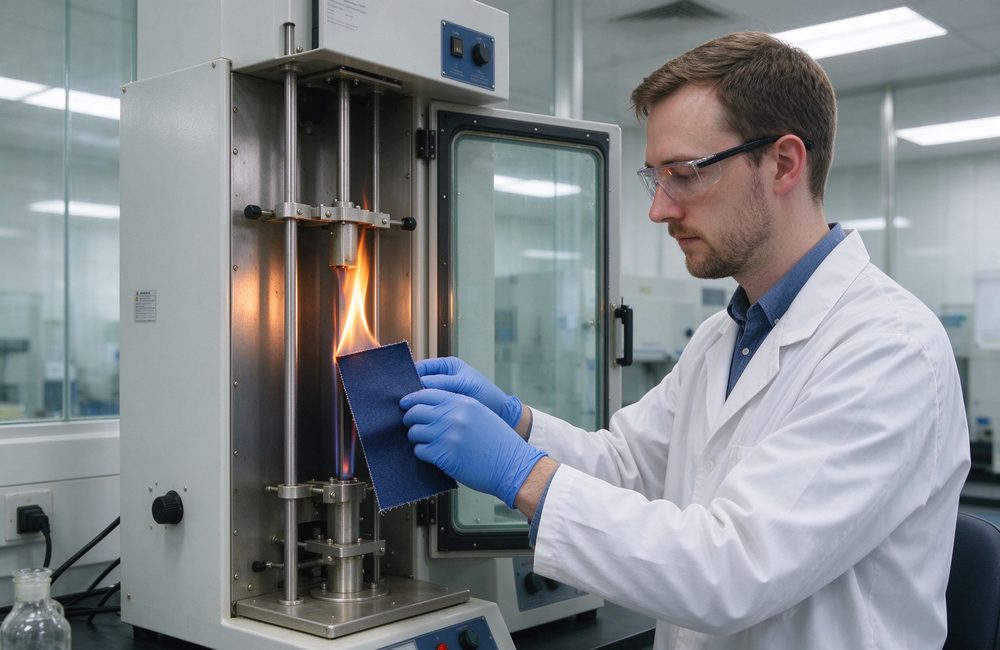
Vertical flame test: afterflame time and char length at a glance
Inherent FR fabric builds flame resistance into the fiber during production — aramid, modacrylic and TECASAFE® PLUS are examples — and the protection never washes out. That makes it the first choice for long-term field roles in oil and power. Treated FR fabric has flame retardant applied to ordinary fabric: it costs less, but the effect decays with each wash and needs scheduled replacement under the care label.
When you compare two FR garments, put the test report and the label side by side: the fiber content on the label should match the tested composition in the report, and the standard number should be identical. Small mismatches here usually mean the certificate belongs to a different garment — a difference that only shows up in an audit.
Ordinary synthetic workwear melts and drips under high heat, and the molten material sticks to the skin, causing deeper and harder-to-treat burns than direct flame. That is why standards such as NFPA 2112 include a no-melt no-drip requirement: the fabric must not melt or drip in the flame test. Confirming that the fabric contains no untreated thermoplastic content such as polyester is the first line of skin protection when you buy.
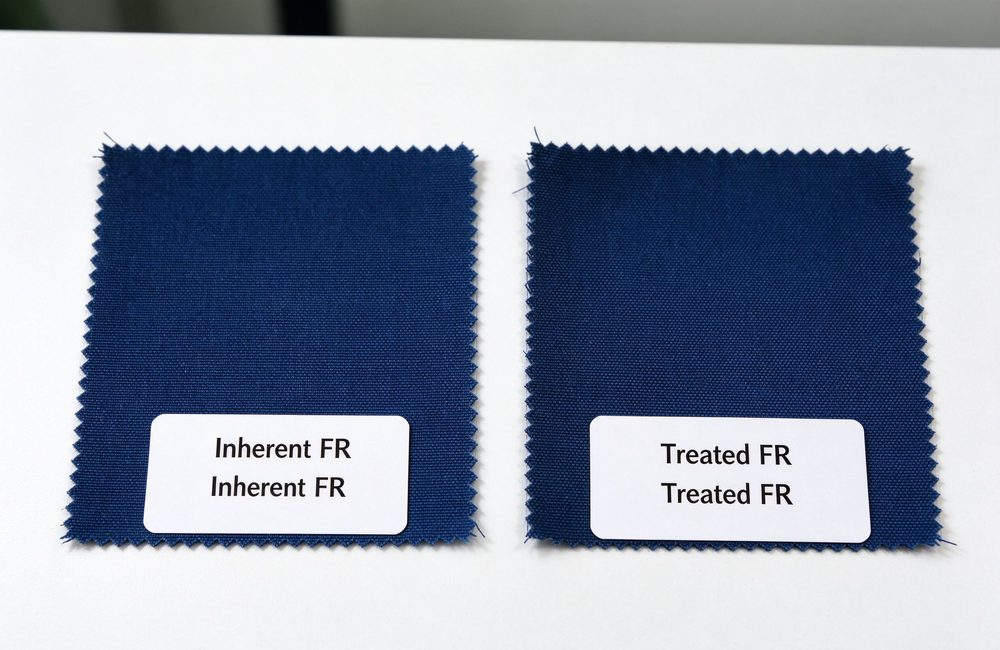
Inherent vs treated: a few washes show the difference
An FR coverall and a firefighter turnout coat solve different problems. Turnout gear enters a burning structure for short missions, with a heavy moisture barrier and thermal liner. A coverall is worn all shift for routine work where fire is possible but not certain. Certification systems differ too: NFPA 1971 governs turnout gear, NFPA 2112 governs FR coveralls. Buy each for its own job.
Fabric is the foundation of FR coverall performance. Mainstream FR fabrics fall into three families: modacrylic blends, aramid blends and FR cotton, with multi-component inherently FR fabrics such as TECASAFE® PLUS as a fast-growing fourth. Each has its strengths; the choice depends on work intensity, climate and budget.
Modacrylic blends are the most widely used FR fabric family: good flame resistance, moderate cost and better breathability than aramid, suitable for most oil and power daily work. The TECASAFE® PLUS FR coverall, for example, comes in S-3XL with custom sizes, meets GB 8965.1-2020, GB 12014-2019, EN 11612, EN 1149-5 and NFPA 2112 — a typical "one garment, multiple scenarios" choice.
Fabric weight is a useful shorthand: lighter fabrics around 200 g/m² suit warmer climates and lower heat exposure; heavier fabrics around 300 g/m² give more heat and abrasion protection for rough work. Breathability varies too — modacrylic blends generally breathe better than pure aramid, and moisture-wicking finishes improve comfort in hot regions. Match weight and construction to your climate and task, not to a brochure photo.
The rule of thumb for welding suits is "resist slag outside, breathe inside": the outer layer absorbs sparks, the inner layer keeps long shifts from overheating. Aramid blends deliver both, which is why they dominate welding workshops.
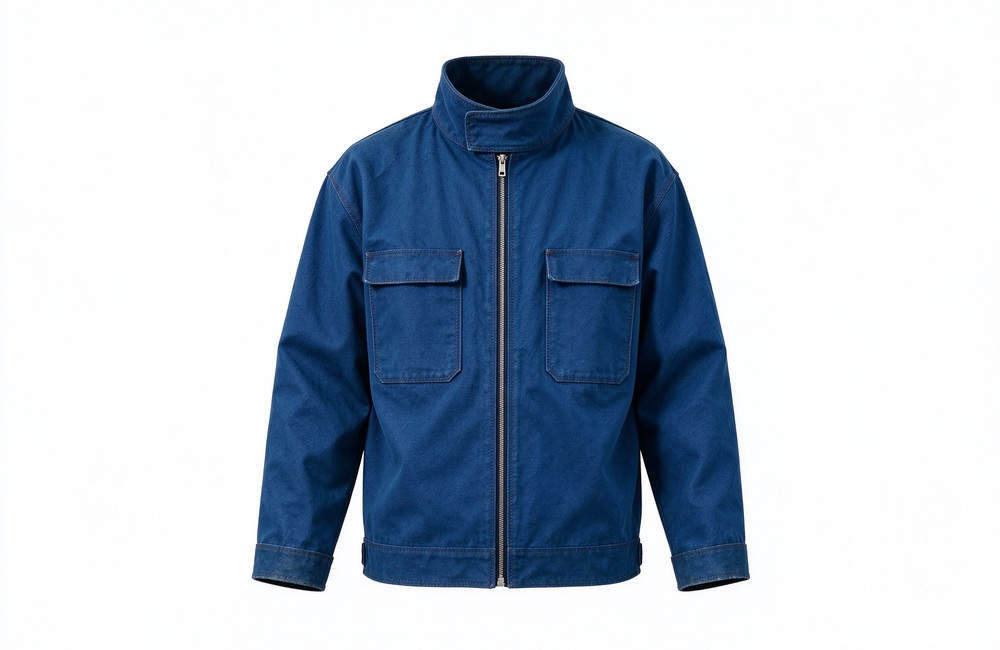
Welding suit: tough outside, breathable inside
Aramid fabrics stand out for heat resistance, strength and abrasion resistance, suited to metallurgy, foundries and welding jobs with higher heat and faster wear. Aramid blends cost more but last longer. The welding suit built on aramid/modacrylic/FR cotton blend and meeting GB 8965.2-2022 is the option designed for these environments.
Aramid has its own limits worth knowing: it is heavier, less comfortable in hot climates, and degraded by prolonged UV exposure if stored poorly. That is why most FR coveralls use aramid in blends rather than 100% — mixing with modacrylic and FR cotton improves comfort and cost while keeping the heat protection. For extreme heat tasks where fabric failure is not acceptable, aramid content becomes the deciding factor.
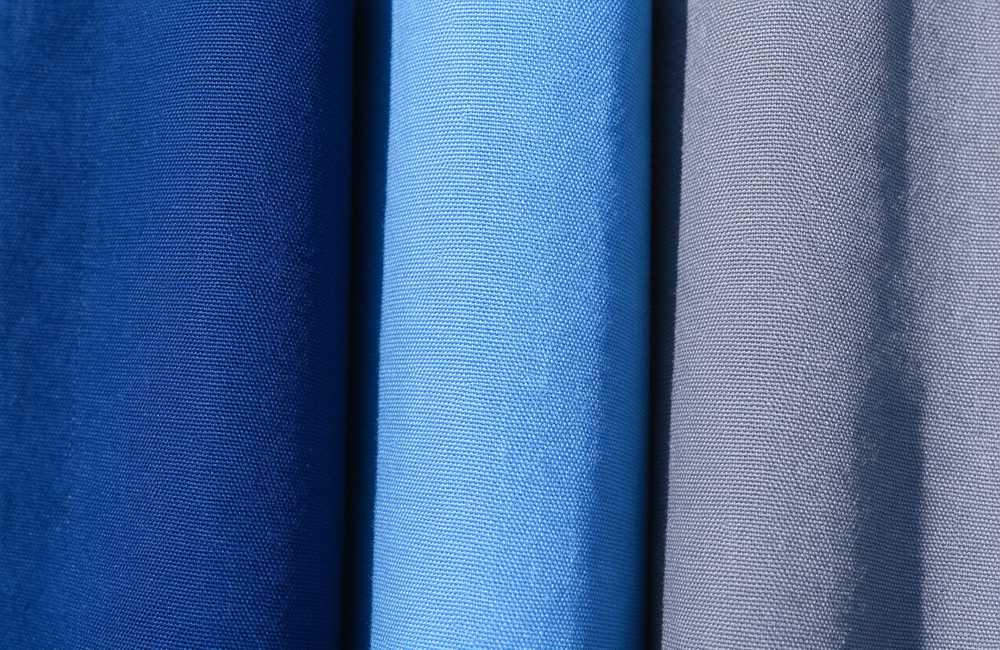
Three fabric families, three hands, one shared trait: inherently FR
FR cotton blends bring flame resistance at a lower price than high-performance synthetics. Cotton breathes well in warm climates, and treated cotton passes the vertical flame test when new. The trade-off is lifespan: after repeated industrial washes the flame resistance weakens, so budget for more frequent replacement. For general hot work and welding shops, FR cotton is a proven entry-level choice.
Standards are the passport of FR workwear compliance. Different markets recognize different standards: North America looks at NFPA 2112, China at GB 8965.1, Europe at EN ISO 11612. For an export-oriented supplier, one test report covering multiple standards means the same garment can enter several markets at once.
Standard
Issuer / Region
Best fit
Key test points
US
Oil, chemical flash fire
Flash fire, no melt no drip
China
General FR clothing
Afterflame, char length
GB 8965.2-2022
China
Welding clothing
Slag, spark contact
EU
Heat and flame clothing
Heat level, flame spread
GB 12014-2019
China
Anti-static clothing
Anti-static
EN 1149-5
EU
Anti-static
Surface resistance
Use the table this way: identify your end market first, then look at the leading standard, and finally ask the supplier for a test report covering that standard. The model number on the report must match the label on the garment — a supplier who offers a "fabric report" but no "garment report" deserves a question mark.
The Chinese FR standard system also covers accessories: gloves, hoods and arc flash face shields carry their own standards, and matching garments with the correct accessory standards is part of a complete quotation. When a buyer asks for "FR clothing", confirming whether they mean GB 8965.1 general FR or GB 8965.2 welding clothing prevents the most common mismatch at the inquiry stage.
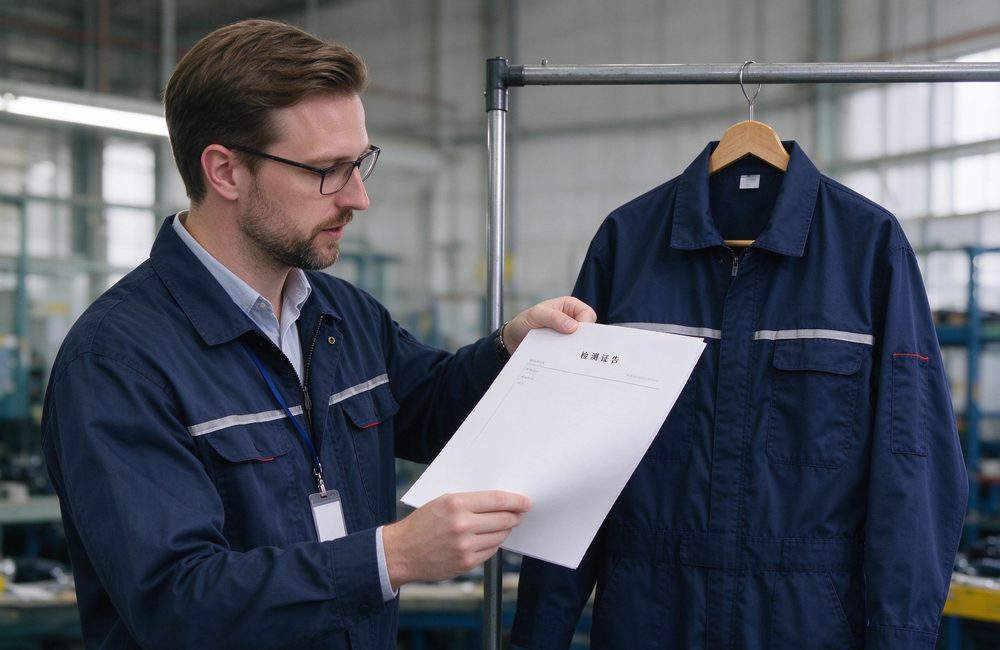
Garment report: model, batch and laboratory all traceable
NFPA 2112 is the benchmark standard for flash fire protective workwear in North America, widely used in oil and chemical industries. It requires the whole garment to pass a full-scale flash fire test, with fabric that does not sustain burning and does not melt or drip, plus rules on fit and coverage. For North American buyers, the NFPA 2112 marking is the basic entry ticket to tender lists.
GB 8965.1-2020 is the base Chinese national standard for FR protective clothing, covering afterflame, char damage and heat protection; GB 8965.2-2022 targets welding protective clothing specifically. For domestic projects or markets that follow Chinese standards, stating "Meets GB 8965.1" with a test report is a sufficient compliance basis.
Standards are region signals as much as safety signals: a US tender expects NFPA 2112, a Chinese tender expects GB 8965, and EU buyers expect EN ISO 11612. Matching the certificate to the buyer’s market is part of the quotation skill — ask which standard the end user will audit against before you offer a price.
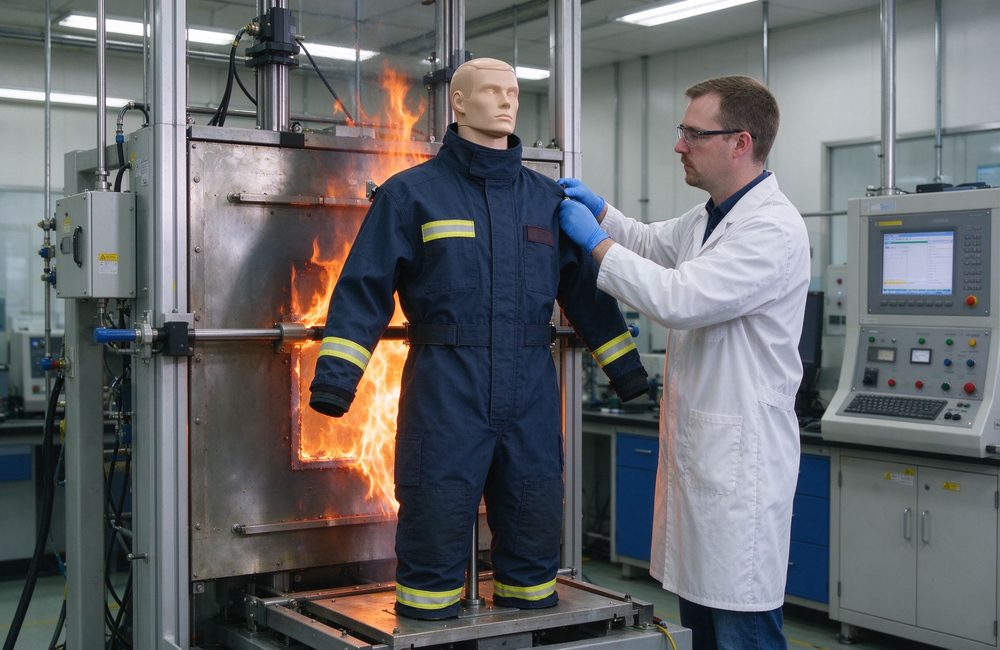
NFPA 2112 whole-garment flash fire test: the full suit is tested together
What makes NFPA 2112 special is that it tests the whole garment, not a single fabric swatch — zippers, seams and collars are all recorded in the flash fire. That is why it has become the purchasing threshold in North America.
For exporters, the practical point is that NFPA 2112 compliance is verified by a certificate from a recognized laboratory, not by a company statement. Ask for the certificate number, the issuing lab and the covered dates, and keep a copy in the shipment file. North American buyers increasingly request this documentation before samples, so having it ready shortens the sales cycle.
NFPA 2112 testing uses an instrumented mannequin in a controlled flash fire, measuring the predicted burn injury across the garment surface. Passing means the complete coverall — not just the fabric — keeps the predicted burn below the standard limit, which is why buyers treat it as the strongest single proof of flash fire protection.
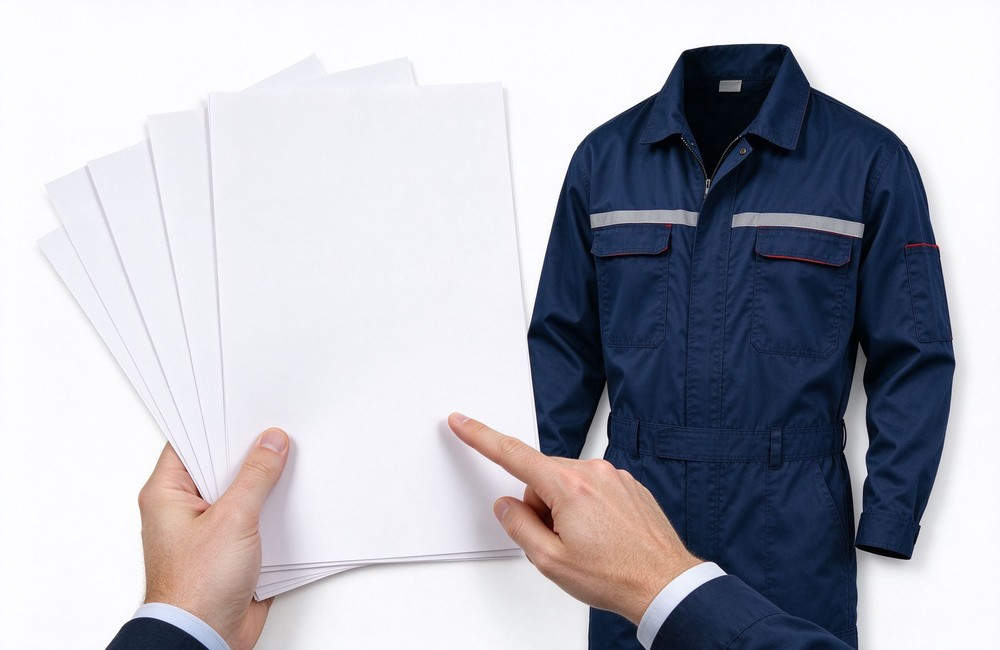
Multi-standard certification: one report, multiple markets
Arc flash exposure is measured by arc rating (ATPV) in cal/cm², from about 8 for HRC 1 up to 40+ for HRC 4 under NFPA 70E. A standard FR coverall protects against flash fire but carries no arc rating. If crews work live electrical panels, ask for arc-rated coveralls with a published ATPV from ASTM F1959 testing — two hazards need two sets of evidence.
A protective garment that does not fit is as good as not worn: too tight restricts movement, too loose catches and snags. FR coverall sizing should span S-3XL and allow custom sizing for the team. Fit-test with real field movements — bending, reaching, squatting, carrying — and make sure the fabric covers and does not bind in any position. Look for an elastic waist or adjustable design so different body types wear it close and comfortable.
Sizing data from the supplier should be real measurements, not generic charts: chest, waist, inseam, sleeve length, and the tolerance between sizes. If most of your team falls between two sizes, ask about half sizes or made-to-measure for those individuals. A good supplier treats sizing as a data conversation — asking for your team’s measurement range before quoting, not after.
Seasonal planning is part of sizing too: summer FR coveralls favor lightweight breathable fabrics, while winter versions add a lining that still passes the same FR standard. Ordering both together also locks a single sourcing file: one supplier, one certificate set and one fit standard for the whole team.
For bulk orders, size by actual team measurements instead of ordering one big size. Record height, chest and waist per worker, distribute sizes proportionally and keep about 10% exchange stock. For outdoor teams working year-round, plan seasonal layers: heavier winter lining and breathable summer styles.
Outdoor teams should configure by season: light breathable styles in summer to reduce heat stress, lined styles in winter to keep movement free. Budgeting by season is more relaxed than an end-of-year rush order.
A structured fit-test takes about ten minutes per worker: put on the coverall, zip up, then run five movements — arms up, arms forward, deep squat, bend forward, and a full stride. Record where the fabric binds, mark the size that passes, and repeat the test after the first wash because fabric shrinks or relaxes. The fitted size list, not the size chart, becomes the bulk order.
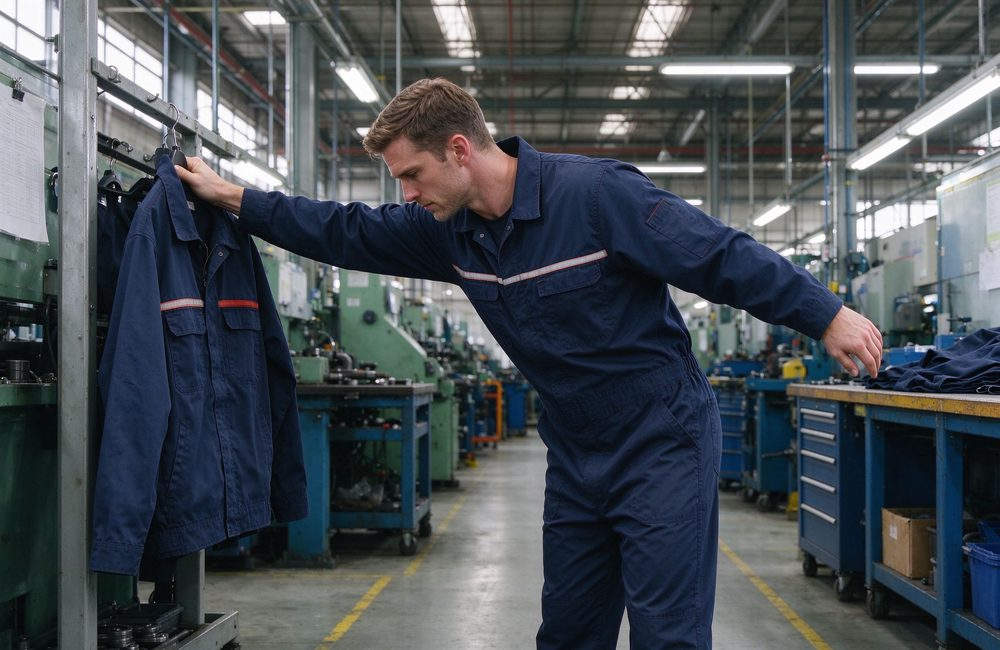
Fit test: coverage in every position
FR coveralls sized from a men’s matrix often fit poorly on women and shorter workers — long sleeves drag and cuffs catch. S–3XL with custom sizing covers the gap: order a separate size run for female crew, and check hip and chest measurements rather than height alone. A correct fit keeps the garment closed and the protection continuous.
In FR workwear wholesale, the supplier's documents decide whether the protection is real. Verify in this order: certificates and test reports first, then fabric and workmanship, then samples for fitting, and finally bulk sizing and customization capability. A reliable verification flow filters out most suppliers who sell "concept flame resistance." For a wider range of fire and protective clothing categories, see our firefighter clothing wholesale series.
A complete FR coverall quotation should name five things: the model, the standard it meets, the fabric composition, the size range, and the certificate attached. Anything less is an incomplete offer. When comparing suppliers, weigh the documentation first — a supplier with full garment reports at a slightly higher price is usually cheaper than one whose cheaper garment fails an audit and has to be replaced.
Comfort has a direct safety dimension: workers who feel overheated or restricted will modify the garment — rolling sleeves, unzipping, leaving it open — and every modification reduces protection. Breathable back panels, gusseted underarms and a cut that allows a full stride matter as much as the fabric specification. When evaluating samples, ask the workers who will actually wear them for feedback rather than judging comfort from a hanger.
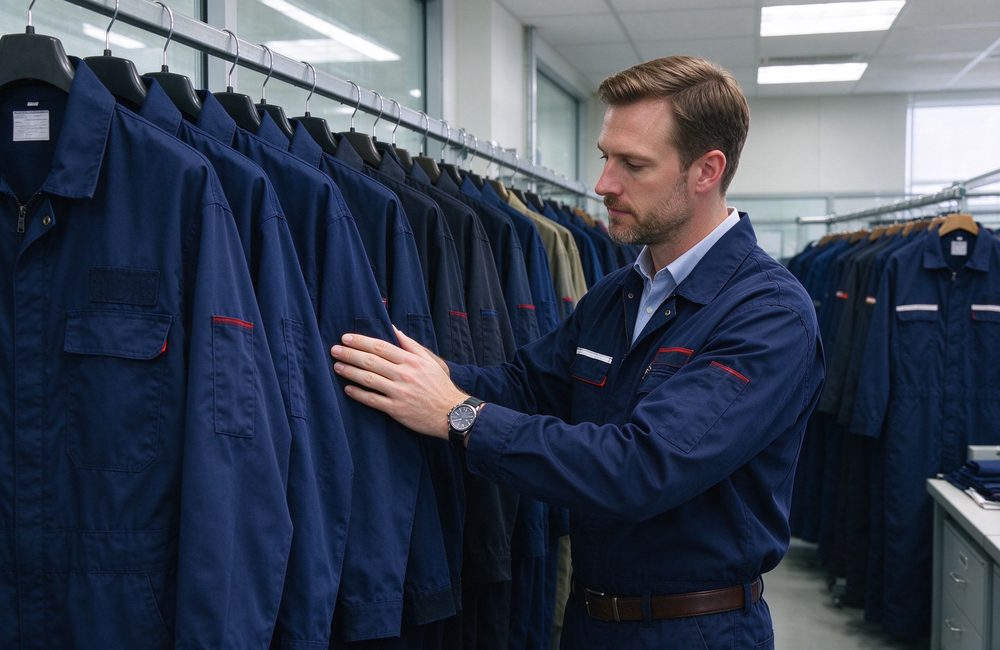
Sample fitting: let the team try before you scale
Use this supplier check table as a quick reference during evaluation. It covers certification, fabric proof, sample fitting and communication — the four areas where a low-cost FR coveralls quote usually hides its gaps. Walk through the rows with your shortlisted suppliers before comparing prices.
Check item
What to ask for
Red flags
Certification
Garment report, model = label
Fabric report only
Fabric proof
Fiber content, FR type
Cannot name fabric
Sample fitting
Samples, team fit before bulk
Refuses samples
Bulk sizing
Team measurements, exchange stock
One size only
Customization
Logo, colors, sizes
No customization
Use this checklist directly as a sourcing request: put every item in the inquiry email, and only suppliers who answer line by line move to the next round. Pay special attention to the test report — confirm it is a garment report (for the complete clothing) rather than a single fabric swatch, because the garment test includes zippers, seams and other critical parts.
The verification order matters as much as the check itself: certificates first, then fabric and workmanship, then fitting samples, and finally bulk capacity. Skipping the sample stage is the most expensive shortcut in FR wholesale.
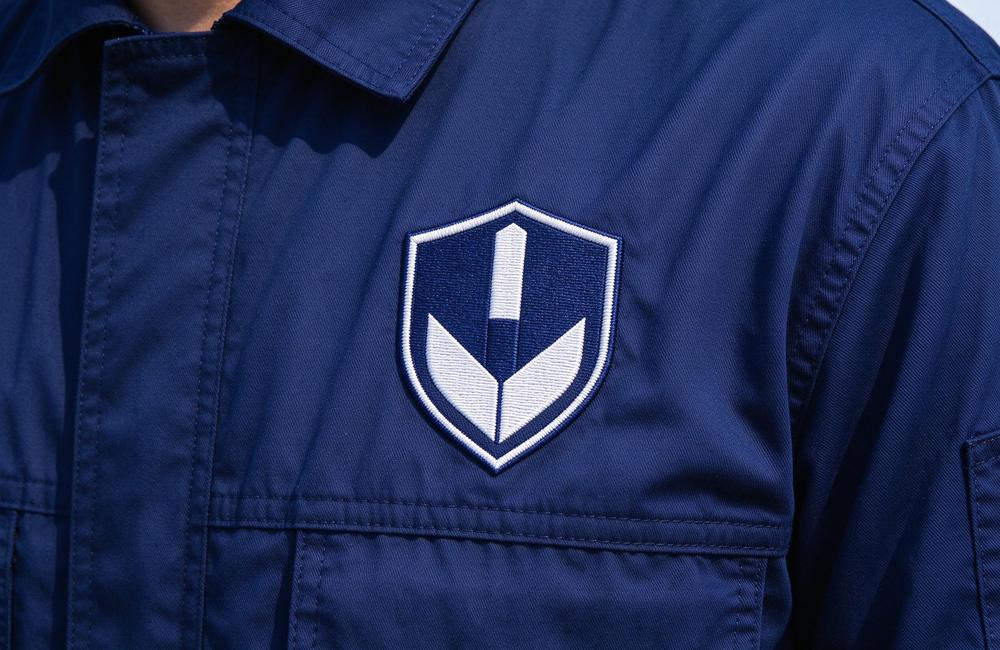
Logo customization: looking good must not weaken protection
A sample order is the cheapest insurance in FR wholesale. Before the container ships, run the ten-minute fit check on real workers: sit, squat, reach, kneel and grab. Confirm the label matches the certificate and the logo matches the artwork. Approve the sample in writing, and the bulk order inherits exactly that specification.
Ask the supplier for fabric and garment test reports and check four numbers: afterflame time, char length, whether it melts or drips, and the heat protection level. The model on the report must match the label, and the laboratory name should be verifiable. Putting "provide test reports" into the contract is far more reliable than a verbal promise.
Ask for both fabric and garment reports and check four numbers: afterflame time, char length, melt or drip, and the heat protection level. The model on the report must match the label, and the laboratory should be verifiable.
Bulk orders usually come with customization: company logo embroidery, specified colors, extended sizes. Confirm the supplier's minimum order, lead time and sampling cycle. Customization must not sacrifice protection — embroidery position and thread selection should avoid critical protection areas, and whether modified garments keep the original certification needs a separate confirmation.
Custom sizing for FR coveralls follows the same principle as standard sizing: measure first, cut second. When the team has a wide height span, offer extended lengths and tapered options rather than forcing one cut on everyone.
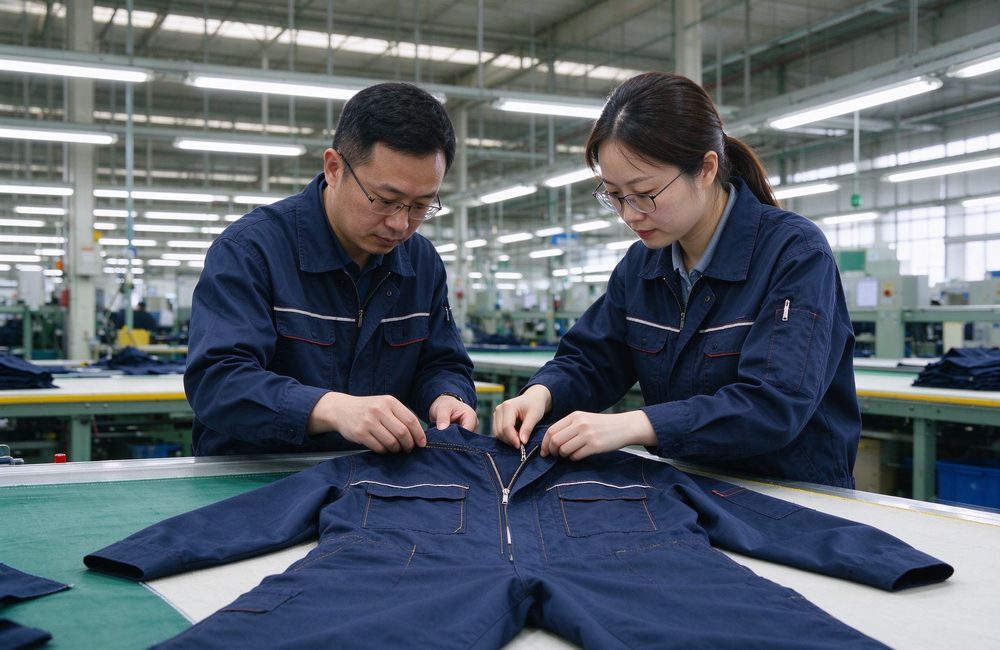
Factory verification: seams, fabric and labels item by item
An FR garment's protection is half fabric and half care. Wrong washing accelerates failure in treated FR fabrics and damages seams in inherently FR fabrics. Hand the washing instructions to the users at purchase time, and make the permanent care label part of the garment acceptance.
Storage is part of care. FR garments should be kept dry, away from direct sunlight and strong heat, on hangers or flat in clean boxes rather than crushed in a drawer. Garments washed, dried and stored correctly keep their protection; garments stored damp or under UV lose it invisibly. Add a monthly check — label readable, no holes, seams intact — into the uniform rotation.
Repair policy is worth agreeing in advance: small seam repairs can be done on site, but any repair touching FR fabric areas should follow the manufacturer instruction or retire the garment. When in doubt, retire it — one coverall costs far less than the risk it covers.
Five rules for FR workwear washing: no fabric softener (it coats the FR finish); no bleach (it attacks fibers and retardant); water below 60°C; wash separately from heavily oiled ordinary garments; air dry instead of high-heat drying. Replace treated FR fabrics on the label's cycle; for inherently FR fabrics such as TECASAFE® PLUS, replace mainly on wear — holes, opened seams or failed zippers mean immediate replacement.
Five washing rules cover most FR workwear: no fabric softener, no bleach, water below 60°C, no high-heat drying, and wash separately from oily garments. For treated FR, the care label cycle is the replacement schedule; for inherently FR, mechanical wear is the signal. Put the washing label on the acceptance checklist and hand it to users at delivery.
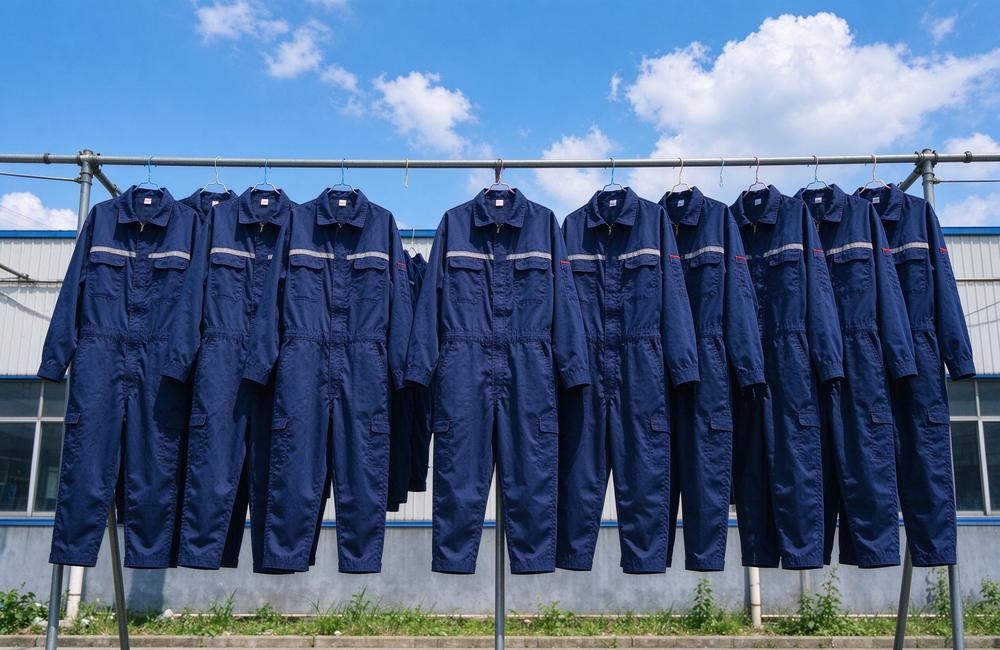
Air dry: FR garment care starts at drying
Drying has its own rules: avoid long direct sun, avoid high-heat tumble, and check zippers and seams after drying. Treat the care label as part of the garment acceptance, and the protection stays online.
Wash frequency depends on the job: oily or dusty tasks need weekly washing, while lower-exposure roles can go two weeks. What matters is that washing follows the label every time. Keep a simple wash log per garment batch so replacement timing comes from records, not memory.
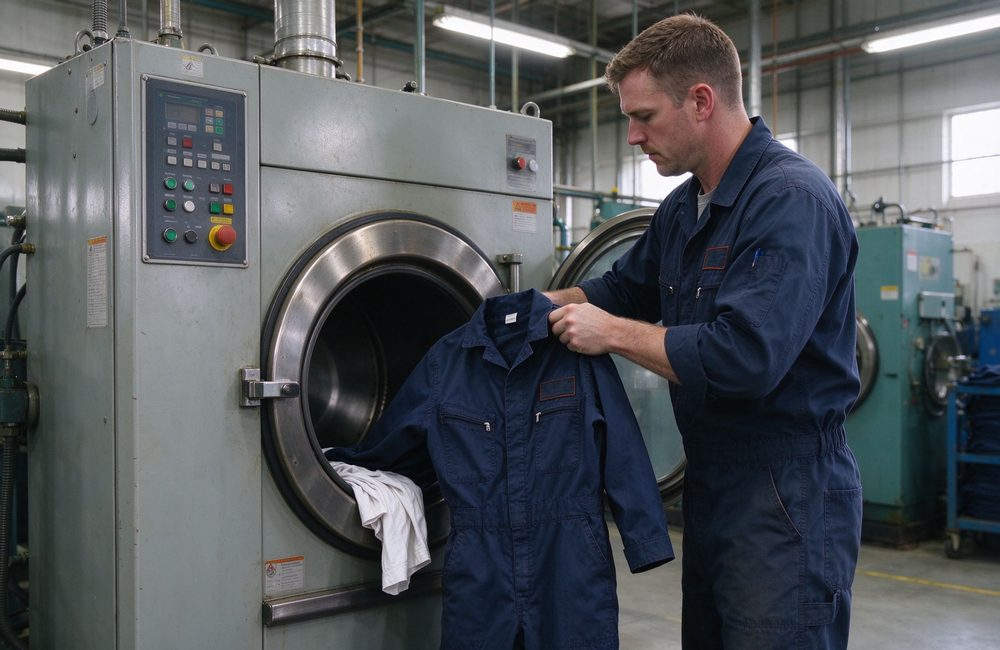
Correct washing: protection does not fade with wash counts
Fabric softener coats FR fibers and can mask the flame-resistant surface; chlorine bleach attacks both treated and inherent FR chemistry. The washing rule is short and strict: no softener, no bleach, no starch. Industrial laundering that follows the garment label keeps flame resistance intact wash after wash.
For bulk FR coverall orders, the written specification is the first protection for both sides. The spec should state: model, standard, fabric composition, size distribution, color, logo requirements, lead time and payment terms. Price depends on quantity, fabric grade and customization; specific minimum order and lead time are per contract.
The contract should also cover the acceptance procedure: how many cartons are spot-checked, what happens when a garment fails inspection, and how sizing exchanges are handled after distribution. Documents — invoice, packing list, test reports, certificate — should be listed as delivery conditions so the buyer receives everything needed for customs and audits.
A practical quantity rule: two to three coveralls per worker for rotation, plus a small spare pool for new hires and damage. Seasonal swaps add a second line item for summer and winter weights. When the written spec, certificate and wash plan are fixed first, the budget number follows the headcount instead of the other way around.
On the day bulk goods arrive, do three things: spot-check label models against the test report, count by the size sheet, and check packaging for damage and moisture. Keep the acceptance record — it is the basis for exchanges and claims.
Photograph the carton marking before unpacking: model, standard and quantity on the label are the evidence base if a dispute about delivery content ever appears.
A simple one-page record — order number, certificate numbers, batch notes and wash dates — turns every future reorder into a five-minute conversation instead of a fresh audit.
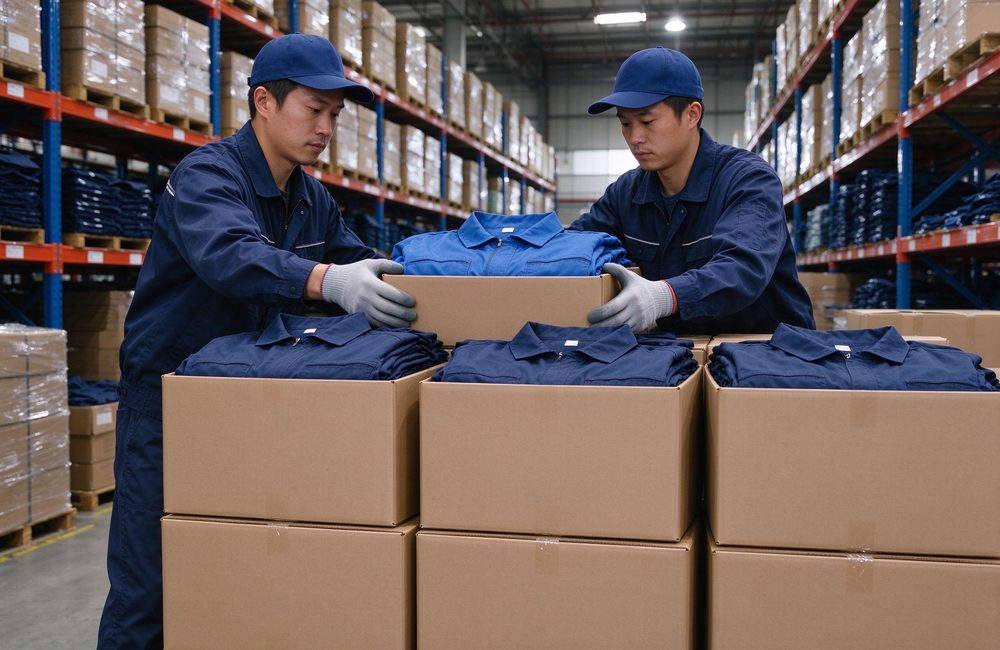
Bulk arrival: verify specs, documents and sizes per carton
For budgeting, calculate by "coverage years per garment": inherently FR fabric costs a little more per unit but offers better life and stable protection, so total cost is often lower. Reserve spares for high-wear parts (cuffs, knees) and split summer breathable and winter lined styles into separate budget lines instead of an end-of-year rush order.
Split the two seasonal styles into their own budget lines: each has its own fabric weight, lining and sizing, and ordering both together keeps one supplier, one certificate pack and one fitting standard across the year.
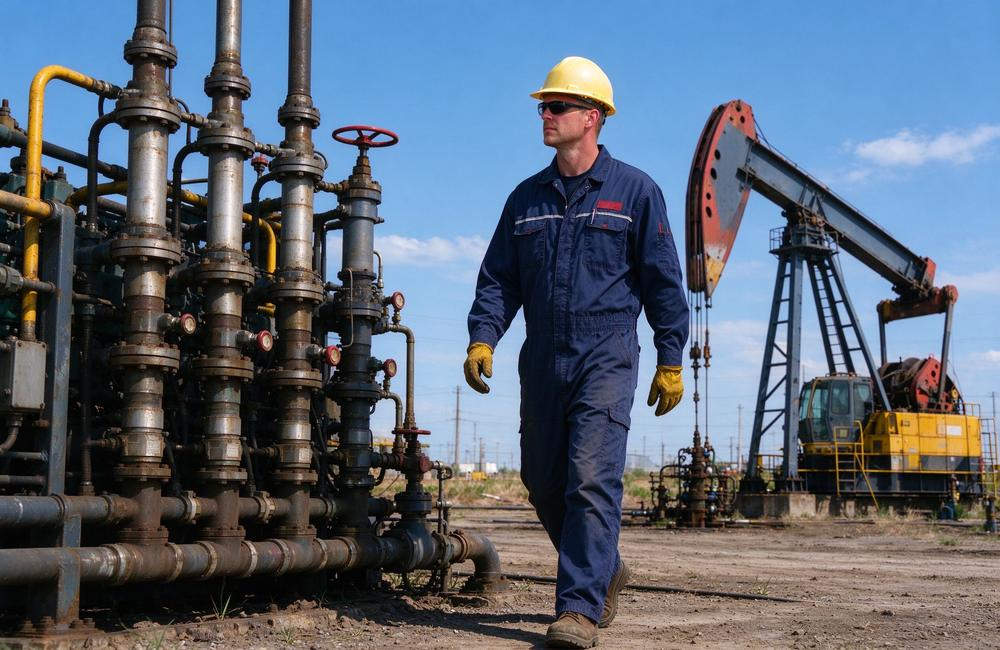
Every FR coverall worn is a worker going home safe
Lock three things first: the garment test report matches the label model, the fabric is inherently FR with confirmed composition, and sizing follows real team measurements. Put the standard and document list into the contract; minimum order and lead time are per contract. Ask for a sample carton before the full order and keep the acceptance record for exchanges.
NFPA 2112 is the benchmark US standard for flash fire workwear, requiring the whole garment to pass full-scale flash fire testing with no melt and no drip. For oil and chemical buyers in North America, this marking is the entry ticket to the tender list. Request the certificate number and issuing laboratory before quotation, and keep it in the tender file.
Welding exposes workers to molten slag and spark splash, so a welding suit built to GB 8965.2-2022 with aramid/modacrylic/FR cotton blends is the recommended choice, balancing abrasion resistance and comfort. Covered pockets and adjustable cuffs close off spark collection points. For mixed welding shops, one aramid blend spec usually covers MIG, TIG and stick work.
Arc flash protection needs an arc rating such as ATPV measured by ASTM F1959. FR clothing provides flame protection, but arc scenarios require a garment that also meets the arc rating — do not substitute general FR. The safety officer sets the required level from the incident energy calculation.
Check three things: a garment test report matching the label model, fabric composition confirming inherently FR, and a sample fitting process. Suppliers who document and customize line by line are worth scaling. A complete quotation names model, standard, fabric, sizes and certificate. Ask for a factory visit or video tour before scaling.
Inherent FR builds flame resistance into the fiber and never washes out — first choice for long-term oil and power roles. Treated FR costs less but decays with washing and needs scheduled replacement under the care label. Over a three-year life, inherent FR usually costs less per protected shift.
Measure height, chest and waist per worker, fit-test with bending and reaching, and keep about 10% exchange stock. Adjustable designs help, and plan seasonal summer and winter configurations. Ask the supplier for half sizes if the team falls between two standard sizes.
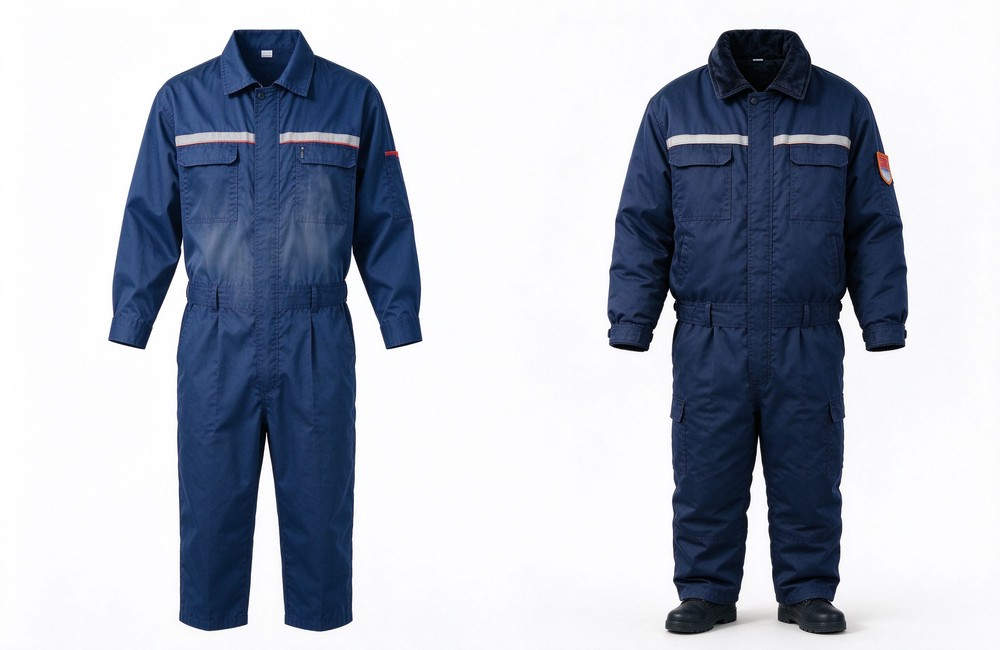
Seasonal planning: one garment system for four seasons in the field
No fabric softener, no bleach, water below 60°C, no high-heat drying, and wash separately from oily garments. Replace treated FR on the label cycle and inherently FR when worn or damaged. Store dry, away from direct sunlight, and check seams monthly. Never dry-clean FR workwear unless the label allows it.
Inherent FR comes from the fiber itself (aramid, modacrylic, TECASAFE® PLUS) and lasts for the garment life; treated FR relies on a chemical finish that washes out. For long-term protection choose inherent FR. The composition label is the fastest desk check. Ask for the fiber percentage on the label and compare it with the report.
Ordinary synthetic fabrics melt and drip under high heat, and the molten material sticks to the skin causing deeper burns. Standards such as NFPA 2112 require no melt no drip, so confirm the fabric contains no untreated thermoplastic content such as polyester in the outer layer. The fastest desk check is reading the fiber content line on the label.
GB 8965.1-2020 is the general Chinese FR protective clothing standard; GB 8965.2-2022 targets welding protective clothing. Write "Meets GB 8965.1" for general FR workwear and size welding suits to GB 8965.2. Accessories such as gloves and hoods carry their own standards. When exporting, name the standard in the contract so delivery and acceptance match.
Yes. Most suppliers offer logo embroidery, specified colors and extended sizes; minimum order and lead time are per contract. Keep embroidery away from critical protection areas and re-confirm certification after modification. Ask for a thread and stitch plan before production, and request a prototype photo before mass production.
Look at four numbers: afterflame time (shorter is better), char length (shorter is better), melt or drip (must be none), and the heat protection level. The data should come from a garment report with a matching label model, from a verifiable laboratory. Keep the report copy with each batch for audit.
Inherently FR fabric: replace on wear — holes, opened seams or failed zippers mean replacement now. Treated FR fabric: replace on the care label cycle. Regular inspection is part of the protection; add a monthly label, holes and seams check to the rotation. Set the check date on the monthly safety calendar.
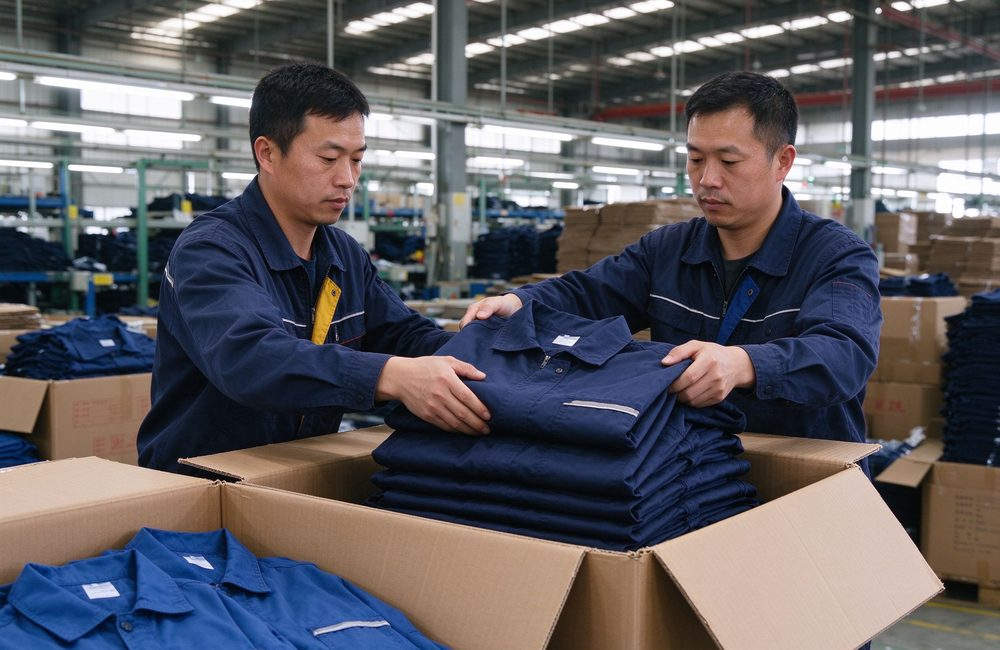
Incoming inspection: model, standard and sizes box by box
This guide is based on industry standards (NFPA 2112, GB 8965, EN ISO 11612). Specific parameters and certifications are subject to product certificates.
Дружні посилання :
Авторське право © Custom Disaster - Relief Bedding: Tents, Sleeping Bags, Blankets Всі права захищені
професійна команда для обслуговування !